
Consulting: Market study for USDA MGD awards
Recibe una notificación push cuando publiquemos vacantes similares.
Expira: 06 Dec, 2026
APLICA YA
Descripción de la Oferta
Scope of Work: Market Study for USDA MGD Awards
| Location: | Honduras |
| Duration/Dates: | December 9, 2026 – January 22, 2027 |
Background:
Catholic Relief Services-United States Conference of Catholic Bishops (CRS) will begin a new iteration of the U.S. Department of Agriculture (USDA) funded McGovern-Dole International Food for Education and Child Nutrition program (MGD). The project’s strategic goal is to improve the literacy and nutrition of school age children in the 28 municipalities of the departments of Lempira and Santa Barbara as well as a focus on nutrition in 6 municipalities in the department of Copán and 4 municipalities in Ocotepeque, Honduras. This program, the McGovern-Dole Food for Education and Child Nutrition Program - ADVANCES: Advancing Access to Nutrition, Capacity Building and Education through System Strengthening was approved in September and will be implemented from October 2026 to September 2031. The project includes a budget of $ 35.3 million. Over a period of approximately five years, CRS will use USDA - donated commodities and any funds provided by USDA's Foreign Agriculture Service (FAS) to implement a school feeding project in Honduras focused on achieving the following objectives:
Strategic Objective 1 (SO1): Improved Literacy of School-Age Children: This objective seeks to strengthen students’ reading and learning skills through improvements in education quality, school feeding, and student retention within the education system
IR 1.1: Improved Quality of Literacy Instruction: Strengthens teacher capacities and pedagogical processes to improve reading and writing instruction
IR 1.2: Improved Attentiveness: Promotes better school nutrition to support learning, concentration, and academic performance
IR 1.3: Improved Student Attendance: Increases enrollment, attendance, and retention through school feeding and other educational support strategies.
Strategic Objective 2 (SO2): Increased Use of Health and Dietary Practices: This objective seeks to promote healthy nutrition, hygiene, and sanitation practices among students, families, and communities
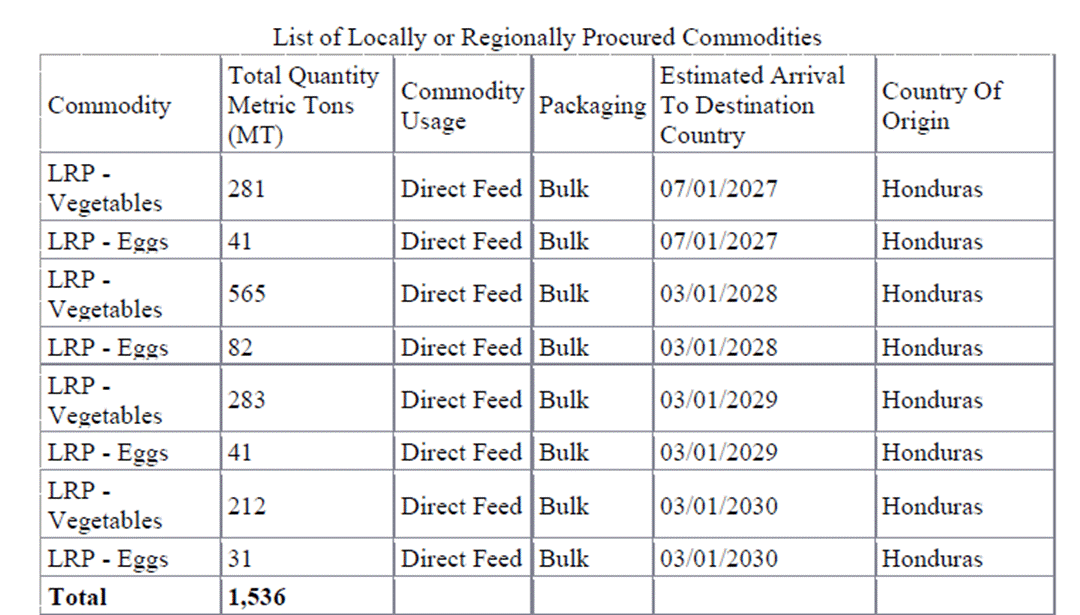
CRS will also implement a fresh ration component in specified municipalities of Lempira consisting of locally or regionally procured fresh vegetable (potatoes, carrots, tomatoes, cucumbers, plantains and others) and eggs.
CRS will import the following commodities:
| Commodity | Usage Type | Total Quantity MT | Estimated Arrival to US Port (Month/Year) | |
CSB+ | Direct Feed | 420 | February 2027 | |
Rice, Fortified | Direct Feed | 330 | February 2027 | |
Beans, Small | Direct Feed | 250 | February 2027 | |
Corn, Yellow | Direct Feed | 940 | February 2027 | |
CSB+ | Direct Feed | 560 | February 2028 | |
Rice, Fortified | Direct Feed | 440 | February 2028 | |
Beans, Small | Direct Feed | 340 | February 2028 | |
Corn, Yellow | Direct Feed | 1890 | February 2028 | |
CSB+ | Direct Feed | 560 | February 2029 | |
Rice, Fortified | Direct Feed | 440 | February 2029 | |
Beans, Small | Direct Feed | 340 | February 2029 | |
Corn, Yellow | Direct Feed | 1890 | February 2029 | |
CSB+ | Direct Feed | 520 | February 2030 | |
Rice, Fortified | Direct Feed | 440 | February 2030 | |
Beans, Small | Direct Feed | 340 | February 2030 | |
Corn, Yellow | Direct Feed | 1270 | February 2030 | |
CSB+ | Direct Feed | 430 | February 2031 | |
Rice, Fortified | Direct Feed | 170 | February 2031 | |
Beans, Small | Direct Feed | 130 | February 2031 | |
Corn, Yellow | Direct Feed | 480 | February 2031 | |
| Total | 12,180 | |||
CRS will procure the following commodities locally:
Purpose of the SOW:
To initiate program activities in the target areas, CRS Honduras will conduct a market study through a comprehensive analysis of the markets related to locally procured food commodities and commodities donated by the program. The study will assess the supply capacity of national and sub-national markets, identify opportunities and constraints within supply chains, estimate the potential effects of procurement and import activities on local markets, and generate the evidence needed to inform the design of an efficient, sustainable, and inclusive procurement strategy that contributes to the achievement of the McGovern-Dole program objectives in Honduras. The study will focus on the following points:
Anticipate the economic impact of donated commodities and procured commodities on Honduras production and markets.
Establish a baseline for market and price monitoring and inform the design of a market monitoring system.
Evaluate the capacity of the market in Honduras at the national level, as well as a review of a sub-national capacity focusing on Lempira and surrounding Departments, to meet the required procurement level(s) of: Eggs, Potato, Yuca, Green Banana, Malanga, Onion, Cabbage, Lettuce, Tomato, Green Pepper, Cucumber, Radish, Carrot, Beet and Chayote.
Recommend adjustments of the pre-existing procurement plan to minimize adverse effects on local markets and/or increase inclusion/benefit for targeted market actors; and
Market Study Objective:
Generate a general profile of the markets for procured and donated commodities, capturing main supply routes; types and numbers of vegetables producers who deliver to MGD, traders and other market actors; market performance; constraints and overall trends to be used for decision making through the LOP.
Key Questions for the Market Study:
What is the estimated impact of procured and donated commodities on demand for targeted commodities?
How do the quantities to be procured by the project compare to the size of the market and/or to supplies available from targeted sellers (e.g. local producer groups)?
In the department of Lempira, what is the seasonality, the current production levels, and aggregated supply of procured Eggs, Potato, Yuca, Green Banana, Malanga, Onion, Cabbage, Lettuce, Tomato, Green Pepper, Cucumber, Radish, Carrot, Beet, Chayote.
What are the quantities available from local production (rice, red beans, Corn Soy Blend Plus (CSB +), vegetable oil, and corn), government stocks, private sector imports, food aid and other sources (e.g. government-to-government donations)?
For donated commodities, what are the closest substitutes produced and/or traded in the country?
- How are supply chains organized, and how well do they perform for the procured commodities?
- Who are the main actors involved in the supply vegetable, eggs, and staple grains chain, including production, processing, marketing, transportation, and storage?
- What is the level of competition within and between marketing levels?
- How do commodities flow in and out of the project area?
- How well integrated are markets in the project area to larger supply markets?
- What impact does seasonality have on the availability and prices of vegetables commodities throughout the year?
- If procured commodities are not harvested/available during the school year, is there sufficient storage capacity at the producer/trader/municipality/school level to store foods until they are consumed?
- Are procured commodities in a form usable by schools? Is fortification of foods required/desired? Is further processing and/or packaging required? Is this processing capacity available locally?
Do procured commodities meet food safety and quality assurance standards? Are certified phytosanitary inspection labs available (consider both private and public sector options)?
What are current or potential bottlenecks in the supply chains of procured and donated commodities?
Are the vegetable producers organized? What volumes of targeted commodities do they typically produce?
What percentage of total production do vegetable producer groups sell? Do they typically market their produce individually or collectively?
Who do groups usually sell their commodities to? Is it expected that sales to the program will displace sales to consumers who depend on their products?
Do the groups perform value-addition to their products (cleaning, sorting/grading, processing, packaging)? If not, who will be responsible for ensuring these services (e.g. producers, groups, schools, project)?
Depending on the capacity/resources of the producer/producer group, they may sell produce at the time of harvest to meet immediate cash needs and/or repay debts incurred during the planting season. Does this timing align with project needs? If not, do groups have the capacity to delay sales (consider linking groups to microfinance, credit/warrantage schemes, etc.).
Do producer groups have storage facilities? Can producer groups transport goods to schools and/or central deliver locations?
- Do producer groups have experience submitting bids? Do they have experience with different contract mechanisms (e.g. contract farming)?
- Do producer groups have experience selling their produce to institutional buyers? Does their produce meet quality and packaging standards?
Assessment Methodology
The study’s final methodology will be developed and finalized by the Consultant, in coordination with the Chief of Party and the MEAL Manager of the Program. Data sources/collection could involve secondary data review, interviews/discussions with CRS and partner staff, and specific community-based key informant interviews (remote or in-person).
Stakeholders that may be consulted include MGD and Agriculture staff, local government officials, vendors (wholesalers, producers), transporters, schools, PTAs.
Key Deliverables:
| Deliverable | Date |
| Publish TOR | November 23, 2026 |
| Receipt of proposals | December 06, 2026 |
| Identify external consultant | December 08, 2026 |
| Award of contract | December 11, 2026 |
| Work plan and methodology | December 16, 2026 |
| Initial Draft report for desk review | January 08, 2027 |
| Presentation of findings and Draft report in English and Spanish | January 15, 2027 |
| Final report in English, no more than 30 pages with preference for less | January 20, 2027 |
Proposed Study Team and Expertise
Consultancy fees
The consultancy fees will be indicated in the contract and will be based on the candidate's qualifications and experience. This will be based on CRS and USDA policies. All other allowable costs associated with the study will be covered by [Project].
Education: Bs in agriculture or related field to the aim of this consultancy. M.Sc. degree in Economics/Agricultural Economics or related discipline will be greatly appreciated it.
Work Experience: At least three years of experience working in international development, preferably with substantial experience working in the Dry Corridor of Honduras.
Skills and Expertise: The candidate should have:
- Demonstrated experience in quantitative analysis and research skills required; preferably, familiarity with commodity markets and price analysis.
- Prior experience in agricultural production estimation, marketing, commodity trading and sales, agricultural statistics methodology development, and market data analysis
- Knowledge of food assistance programs and school feeding programs; familiarity with USDA/MGD a plus.
- Previous experiences conducting market studies or baselines in Honduras or the region and/or other developing countries are highly desirable.
- Demonstrated self-motivation, attention to detail, team building, and communication skills.
- Computer proficiency with good knowledge of MS office (Word, Excel, PowerPoint).
- Excellent analytical and report writing skills.
Timeline
The consultancy will take place between December 11, 2026, to January 22, 2027. Deliverables
The Consultant will deliver one comprehensive report that includes market analysis for procured and donated commodities identified in the Scope of Work. The Consultant will submit the following to McGovern-Dole for review and approval:
- Work plan and methodology (including data collection and analysis plans) for approval prior to beginning of the work;
- Presentation of the preliminary findings before submitting the final report;
- Draft reports presented to McGovern-Dole project to allow comments by Chief of Party and MEAL Manager of MGD project.
- Revised and final report.
Deliverables 1-3 can be presented in Spanish, however the draft report and final report are required in English.
Report outline example:
- Executive Summary
- Introduction
- Objectives of the market study
- Methodology and limitations
- Discussion of results
- Overall market context
- National level, including influential market and supply chain trends locally/regionally/globally
- Project implementation zones
- Relevant national policies
- Donated Commodity 1
- [CP to provide] School feeding commodity requirements
- Description of supply chain
- Economic impact analysis: demand dynamics, sources and volumes of supply, market functionality, bottlenecks
- [CP to provide] Procurement plan (per CRS’s agreement with USDA)
- Donated Commodity 2
- [CP to provide] School feeding commodity requirements
- Description of supply chain
- Economic impact analysis: demand dynamics, sources and volumes of supply, market functionality, bottlenecks
- [CP to provide] Procurement plan (per CRS’s agreement with USDA)
- Donated Commodity 3
- [CP to provide] School feeding commodity requirements
- Description of supply chain
- Economic impact analysis: demand dynamics, sources and volumes of supply, market functionality, bottlenecks
- [CP to provide] Procurement plan (per CRS’s agreement with USDA)
- Locally procured commodity 1
- [CP to provide] School feeding commodity requirements
- Description of market actors
- Description of supply chain infrastructure
- Post-harvest value-added activities
- Economic impact analysis: demand dynamics, sources and volumes of supply, market functionality, bottlenecks
- Producer storage and warehouse capacity
- [CP to provide] Procurement plan (per CRS’s agreement with USDA)
- Locally procured commodity 2
- [CP to provide] School feeding commodity requirements
- Description of market actors
- Description of supply chain infrastructure
- Post-harvest value-added activities
- Economic impact analysis: demand dynamics, sources and volumes of supply, market functionality, bottlenecks
- Producer storage and warehouse capacity
- [CP to provide] Procurement plan (per CRS’s agreement with USDA)
- Overall market context
- Health and food safety
- Study conclusions
- Recommendations
- Specific recommendations for the procurement plan
- Weaknesses in markets/procurement strategy that should be regularly monitored
Submission of Offers
Interested candidates should submit a Curriculum Vitae, as well as a technical and financial proposal in English or
Spanish. The technical proposal should be 2 pages maximum and provide a brief overview of the methodologies and approaches the consultant will use to achieve the study’s objectives. The financial proposal should include a breakdown of all costs. The date of submission of offers shall be December 06, 2026, via email to Marbella Chandias: marbella.chandias@crs.org.
Recuerda que Hondutrabajos nunca solicita pagos por postulación.
Si sospechas de esta oferta, repórtala de inmediato.
Otras vacantes que te podrían interesar
Ver Todas en Consultorías →
Especialista Ambiental, Social y Monitoreo CASM – Santa Barbara.
OCP/Secretaria de Recursos Naturales
Coordinador(a) del Proyecto CASM Santa Barbara
OCP/Secretaria de Recursos Naturales

EXPERTO EN CONTENIDO DERECHOS HUMANOS
FUNDACION DE LA UNIVERSIDAD NACIONAL AUTONOMA DE HONDURAS
Postúlate a esta vacante
Consulting: Market study for USDA MGD awards